
Photo
Anh Nguyen
Text
Hoang Huong Tra
Location
Hanoi, Vietnam
Time
2022
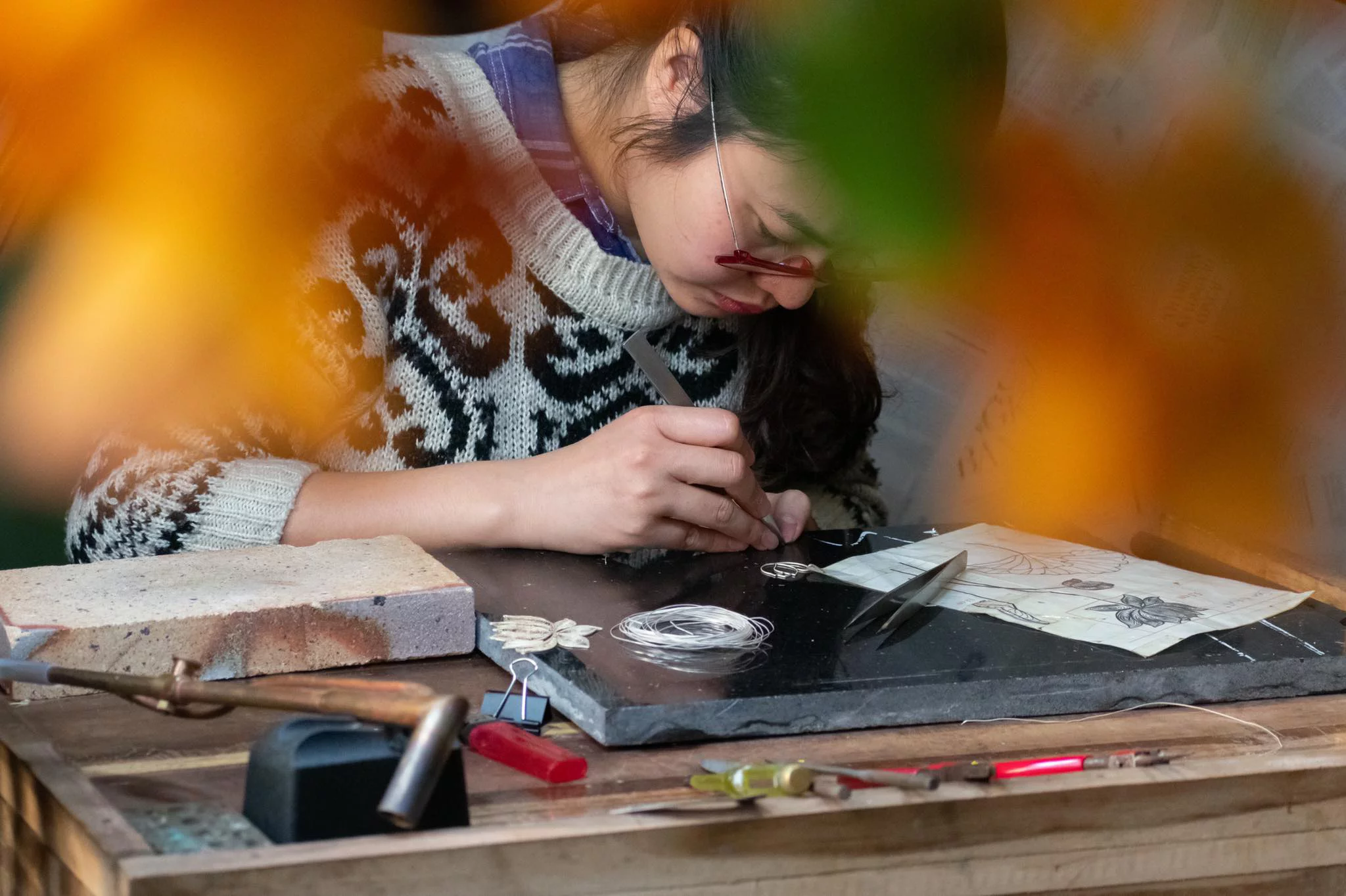
Visiting Pham Thanh Huyen on a busy day, our conversation unfolded with ease. Since the founding of Silver Soul Studio, there have been many stories to tell. For Huyen, the jewelry workshop is both a way of life and a reflection on a traditional craft that is gradually disappearing in Hà Nội.
That afternoon’s conversation is distilled into a few short exchanges, offering a glimpse into Huyen, Silver Soul, and her ongoing path with silversmithing.


Why did you choose traditional silversmithing over more mass-production methods? What were the initial challenges you faced?
Pham Thanh Huyen (PTH): I first discovered and fell in love with silversmithing in 2017 during a trip to Myanmar, but back then, I had no knowledge or information about the craft. Upon returning to Vietnam, I began researching silversmithing techniques, mostly online. By chance, I came across an interview with a silversmith from Định Công. I was deeply impressed by the handmade silver pieces crafted by him and his workshop. Until then, I had only seen mass-produced jewelry in Vietnam. Most importantly, I learned that this was a dying craft. I thought it was a shame that something so beautiful and intricate, a craft with a 1,000-year history, was being pursued by so few. The silversmithing technique of Định Công is one of the four most esteemed traditional crafts of the ancient Thăng Long capital: “Yên Thái silk, Bát Tràng ceramics, Định Công silver, Ngũ Xã bronze.” Compared to the other three, Định Công silversmithing is now rarely preserved. I visited that workshop, learned directly from the artisans, and spoke with them. The moment I saw their handcrafted silver pieces up close, I decided to start learning in August of last year (2019).
The workshop members were always supportive and encouraging to young people wanting to learn, but in reality, few could stick with it. The craft’s challenges are significant. Silversmithing requires immense patience, dexterity, and meticulous attention to detail. Every movement must be steady, and the designs must be harmonious and balanced. It typically takes at least two years to become proficient, depending on one’s dedication, hand skills, and aesthetic sensibility. Initially, the pay is very low, around 2-3 million VND per month, based on the pieces produced only after apprentices have trained for a while and can assist with simpler tasks. For the first 8-9 months in 2020, I earned no income (as I was only learning, not producing for the workshop) and relied entirely on my savings, so I understand why others might struggle. You need a certain financial stability and willingness to take risks to pursue this craft.
There were also challenges with the working environment. I used to work in an air-conditioned office for 8 hours, cool in summer, warm in winter. It was completely different from spending all day in a silver workshop surrounded by machines: rolling mills, welding torches, furnaces…


Beyond the workshop and its machines, what is the surrounding environment like?
The workshop is next to the Temple of the Craft Ancestor and the Đông Hý Đông Hải Dực Vũ Đại Vương communal house. I value that setting. It gives the work a sense of continuity and belonging.
And what about the people?
The artisans are sincere and supportive. They work like a family, helping each other with care. After work, they go fishing or play shuttlecock together. Although this is an artistic craft, they are approachable and grounded.
Why is Định Công silversmithing less known today?
Most of the artisans are older, the eldest is 50 years old and spend their days working with materials and machines. Promotion is limited. Even if awareness were greater, the shortage of artisans means production could not meet demand. Few people today have the qualities needed to stay with the craft, and fewer still are joining. The number of skilled artisans is shrinking, and without a younger generation, the workshop cannot expand. At present, there is only me and one other female apprentice, born in 1997.
What challenges does the workshop face in training new artisans, beyond attracting talent?
To train an apprentice, their basic living needs must be met in the early stages. Since there is little to no income at the start, and the workshop lacks the resources to support learners, it becomes difficult to retain them.

After more than a year as an apprentice, how do you feel? How has your daily life changed?
Phạm Thanh Huyền: At first, no one thought I would stay long. For four months, I balanced it with an office job, working in the day and learning in the evening. Later I left my office work and apprenticed full time. I had no clear plan to return to my old career. The more I worked, the more I wanted to continue.
At one point, I tried applying for office jobs again, hoping to earn income while learning. But I soon stopped. I realized I was too committed to the workshop. I decided to use my savings to continue until I could no longer manage. By September 2021, I began to think of developing further and testing myself. That was when I opened my own shop. Silver Soul Studio began there.
I still value the language-related work I did for four years. It gave me skills and experience. But silversmithing felt like a different path, and I embraced it.

What is most important to you now, both as a maker and as someone running a business?
The most important thing is a serious attitude toward the work. If something is off, if a weld is not clean, I try again. I know these techniques take years to master, and my hands are less skilled than others in the workshop, but I keep reminding myself to respect the craft. I also believe a product needs a spirit.
I want each piece to feel complete in technique and also carry the emotion of the maker. We use pure silver (999), soft enough for fine detail. For me, a piece that combines quality, technique, and meaning is different from mass production. When customers receive it, they will see its value.

What’s next for you and for Silver Soul Studio?
I will keep refining my skills and creativity, always reminding myself to continue learning. I also hope to open a shop in Hội An. Its cultural setting and visitors would be a good place for handmade silver work.
Thank you for sharing your story.