
Text
Hoang Huong Tra
Photo
Anh Nguyen
Location
Hanoi, Vietnam
Year
2022
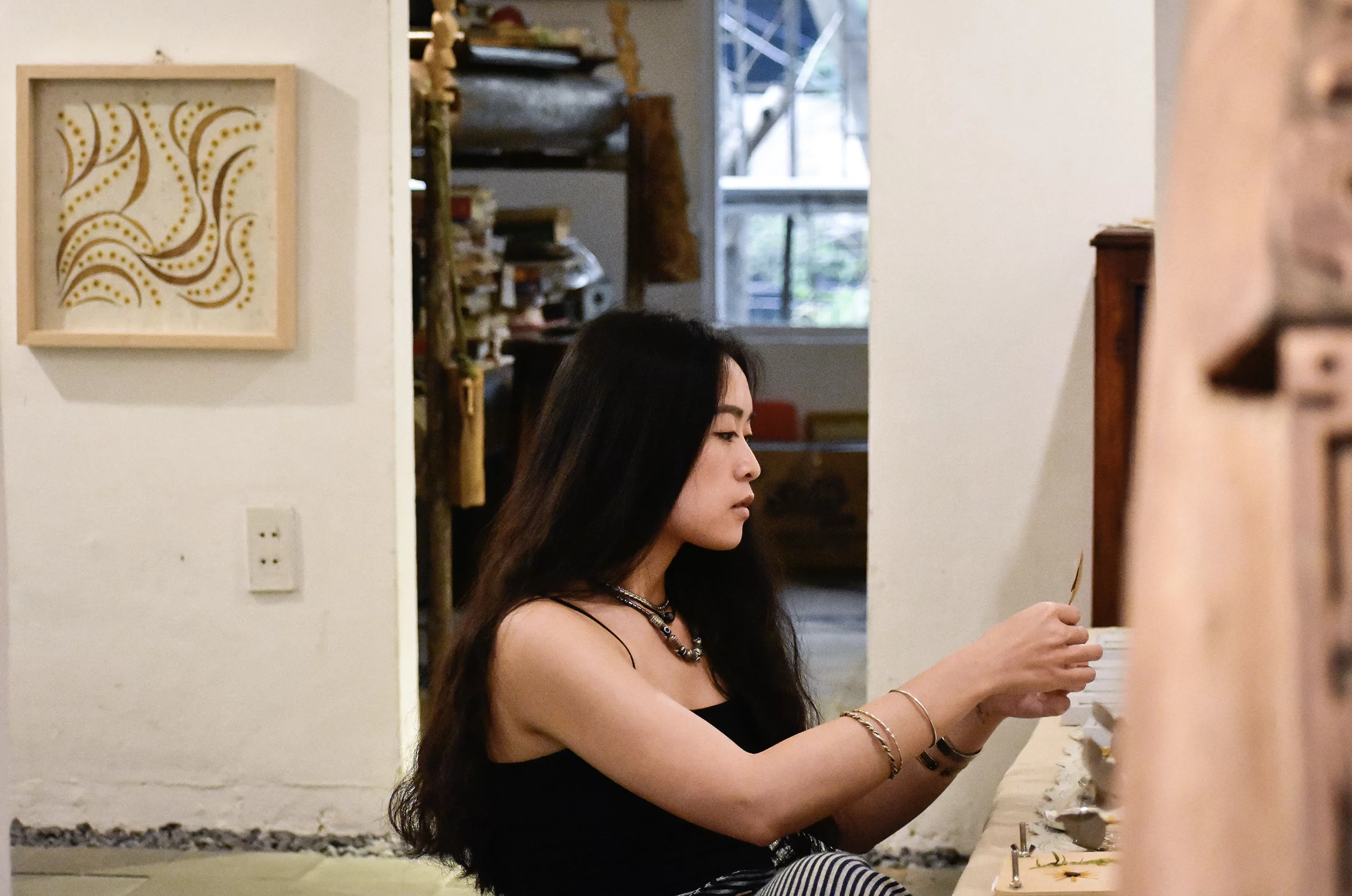
Stepping into Lyn Nga’s studio feels like crossing into a vivid universe where every corner hums with creativity. Shelves overflow with richly colored fabrics, while the walls are alive with sketches, framed photographs, and easels waiting for the next stroke of inspiration. Brushes, paints, and tools sit alongside pots of greenery and freshly arranged flowers, infusing the intimate room with a sense of both artistry and life. The woman who inhabits this space carries the free-spirited essence of 1970s femininity, a presence that left a lasting impression from the very first meeting.
She revealed that the studio itself is as personal as the work it shelters. Her father built the structure with his own hands, from the wooden staircase to the walls and floors. She added her own imprint by painting the first layers of color, planting the greenery that now softens the edges, sewing the curtains, cushions, and tablecloths, and carefully gathering the small objects that complete the room. Each detail feels intentional, each gesture an act of care, together shaping an environment that is not just a workplace but a portrait of its maker.

When did you begin collecting and pressing leaves and flowers?
Lyn Nga: The very first leaves I picked up and saved were during my student years, more than a decade ago. At that time, I was traveling frequently, and wherever I went I felt the need to bring back a fragment of its spirit. By the sea, I would gather seashells, pieces of coral, or simply a handful of sand. In the forest, I collected moss, ferns, fallen leaves, and wildflowers. Whether in a bustling city or a quiet countryside village, I always searched for a patch of greenery, standing beneath the trees and looking down to see what nature had left behind.
Collecting smaller leaves or delicate flowers was effortless, a simple notebook was enough to preserve countless specimens. Larger or more complex blooms, however, required special tools and greater precision. For the past five years, I have been experimenting with a more meticulous, almost technical approach to pressing flowers, refining the process with each attempt.
With such a diverse collection, do you still remember where these leaves came from?
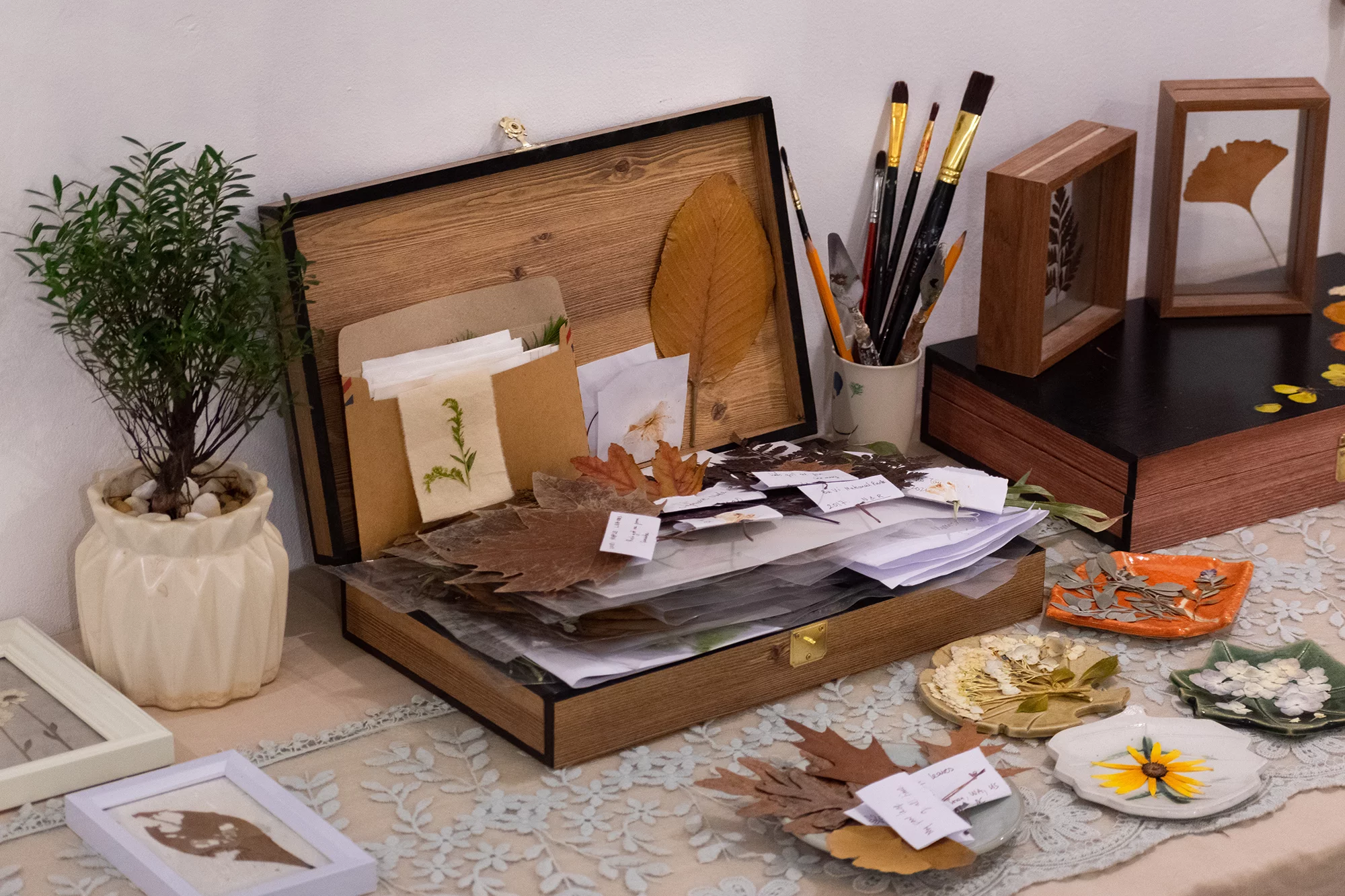
Lyn Nga: The ones that hold a special meaning stay with me vividly—each leaf feels like a frame from a slow-motion film, complete with its own story and setting. For the others, I don’t always remember every detail, so I often write notes: the place, the moment, the reason I chose to keep it, and the story it carried with it. My close friends know me well enough that when they return from a trip, they never have to bring gifts. A handful of leaves or a small flower is enough to fill me with quiet joy for the whole day.
Over the years, this habit has created a collection that spans across Vietnam, Japan, South Korea, India, Canada, the United States, Germany, France, and Australia. Some leaves still carry traces of garden soil or the fine dust of forest paths, others shimmer with the residue of city streets. I never wash or treat them. I prefer to preserve them exactly as they were found, holding onto their rawness and memory.
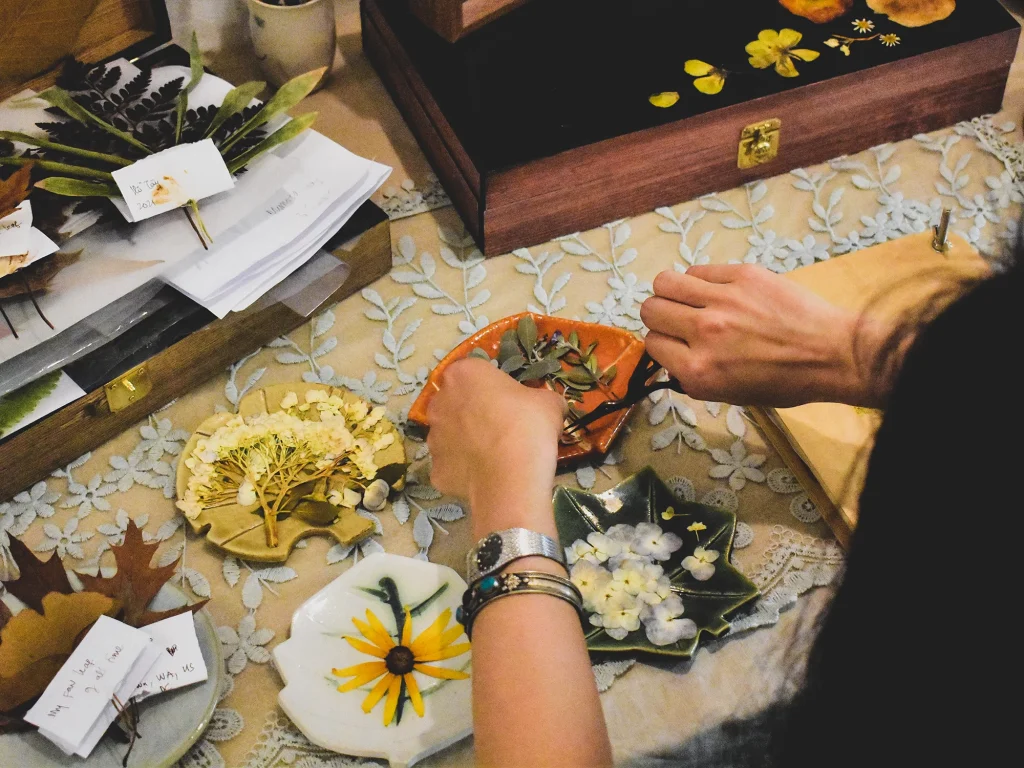
How do the leaves and flowers change after being pressed?
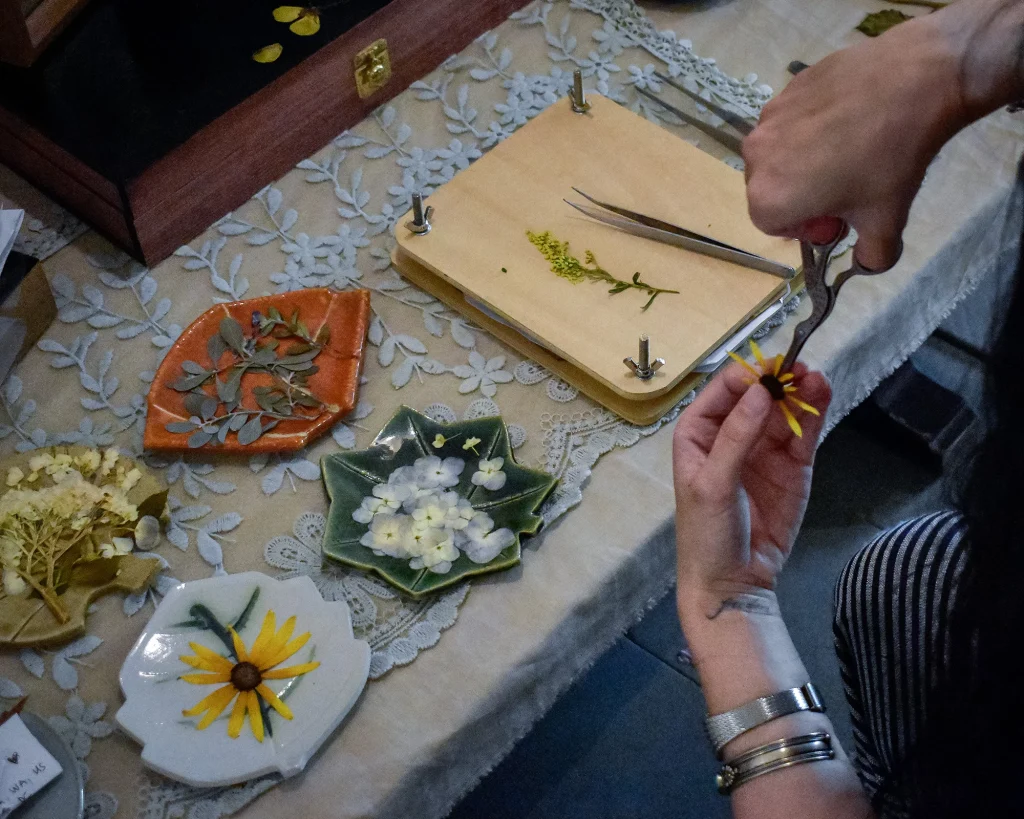
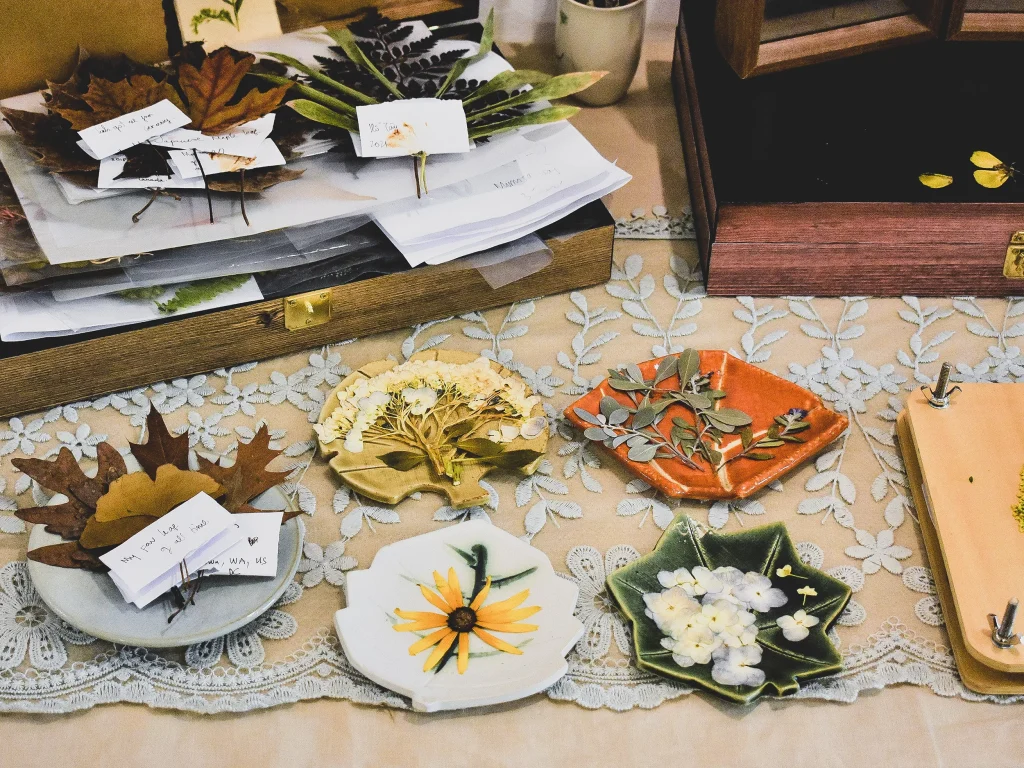
Some leaves, when freshly picked, are thick and sturdy, yet after pressing they become astonishingly thin, almost translucent, like silk or gossamer. Maple and ginkgo leaves tend to preserve their colors beautifully, while others shift dramatically, sometimes fading into shades of brown or even turning completely black.
Pressing leaves can be as simple as placing them between the pages of a book. Flowers, however, are far more complex because of their three-dimensional forms. Their transformation is unpredictable; delicate stamens and layered petals often behave in surprising ways. Orchids, with their thick, moisture-rich petals, are particularly fragile and can easily mold or break without the right conditions. Daisies sometimes need to be split and pressed in halves, while roses often require the removal of certain petals. The process demands specialized tools, careful labor, and patience. Flowers are fleeting in their natural state, and for me, pressing them is a way to hold onto their ephemeral beauty.
How long does it take you to complete a pressed flower and leaf arrangement?
Like painting or designing, the actual act of composition is not what takes the most time. It is the ideation, the research, and the evolution of the concept that require patience.
There was a piece that came to me suddenly in the middle of the night. I woke with the idea, began working immediately, and by morning it was complete after about five or six hours of focused labor. Yet other works have stretched across a year. If the flowers I needed were out of season, I had to wait patiently for the next bloom. Once pressed, the flowers must dry for two to five weeks before they can be arranged and the piece finally brought to life.

There’s a piece I poured my heart into, using flowers and leaves I’ve gathered over more than a decade. It carries within it the materials from my travels, the emotions of stepping into new places for the first time, the months I spent sleeping rough while working on documentary film projects, the days devoted to conservation work in national parks, the milestones in my career, the shifts in where I lived, the loves, the bonds deeper than family, the encounters, the joys and sorrows, and even the “hunts” for discarded blooms on the streets after Tết, Valentine’s Day, or International Women’s Day. A decade of my own growth and transformation is held inside that one piece.
Many people have asked to buy it, but I have chosen to keep it. One day, when I am old and my memory begins to fade, I want to look at it and relive that tempestuous, life-defining decade (laughs heartily).
What is it about pressing and arranging flowers and leaves that captivates you?
It is the raw, unembellished beauty of nature. Flowers, leaves, and plants always remind me that humans are only a small part of a much greater whole.
Still, I follow what I call the one-in-twenty rule: I only pick a flower or a leaf if at least twenty remain. It is my way of leaving beauty behind for others to enjoy and of protecting the plants from being stripped bare. If I let myself take everything simply because it was too beautiful, there would be nothing left to gather the next time (laughs).
I heard that Frida Kahlo and Azuma Makoto are among your inspirations. What impressions do you have of them, and how have they inspired you?
In Frida Kahlo’s paintings, nature appears again and again, captivating me not only with its imagery but also with her extraordinary resilience and her immense love for art. For two Halloweens in a row, I even dressed up as Frida (laughs).
Azuma Makoto, the Japanese flower artist, has an extraordinary ability to create beyond boundaries, which I deeply admire. His installations are breathtaking, whether set in deserts, sunk into ocean depths, buried in snow, or launched into space. I also love the way he juxtaposes flowers with artificial objects, creating unexpected contrasts that expand the language of his work.
Is there a specific place you would love to visit to collect flowers and leaves, and what types would you seek?
My fiancé’s hometown. He is a biologist, and he has told me about so many fascinating plants and flowers that I have yet to see with my own eyes. Since this place will eventually become my home as well, I want to fall in love with the land through every leaf and every branch.
I dream of seeing forests of maple, pine, and fir, of touching blue flag iris, trillium, mayflower, and mountain avens roses, and of gathering mosses, lichens, and ferns in the national parks.
What type of flower do you usually give to loved ones on special occasions?
Lyn Nga: I always choose gifts according to what the person loves. I only give flowers to those who truly appreciate them, otherwise, what would be the point of offering flowers to someone who does not care for them? (laughs)

The centerpiece of the article highlights leaves and flowers gifted by friends from across different countries and moments in time, brought together in an exhibition co-organized by Lyn Nga and Artistay in March 2021.