
Author
Phuong May
Photo
Phuong May
Location
Nghia Hung, Nam Dinh, Vietnam
Edited by
Anh Nguyen
The Vietnamese conical hat is a familiar presence, inseparable from the image of mothers and grandmothers in the countryside. Yet behind its graceful silhouette lies a meticulous craft tradition that few outside the villages truly understand.
On a recent visit to Nghĩa Châu in Nghĩa Hưng District, Nam Định Province, I had the chance to step into one of these craft communities and witness how the iconic hat is brought to life. The commune lies just seventeen kilometers from Nam Định city, easily reached along quiet rural roads. Local elders recall that Chu Văn Phàn was the figure who first introduced the craft to Nghĩa Châu. In the years following the August Revolution of 1945, Phàn traveled with friends to Chuông Village, a place long celebrated as the country’s center of conical hat making. At that time, the hat was an indispensable possession for farmers, shielding them from sun and rain during long days in the fields, always paired with the traditional palm-leaf raincoat. Recognizing its importance, Phàn returned to Chuông in 1946 and invited skilled artisans to teach the craft to his family and neighbors.


Early Nghĩa Châu hats closely followed the Chuông model, with twenty rings and blackened lower rims produced through smoke curing. Later innovations in the hamlet of Đào Khê refined the form to sixteen rings with white stitching and pale rims, and by 1975 the design had evolved into the fifteen-ring hat still produced today, now sewn with nylon threads in white or subtle colors.
In Đào Khê, the practice continues to be nurtured with deep devotion. Children as young as thirteen learn from their mothers and grandmothers how to stitch, shape the rings, and layer the leaves. Visitors to the hamlet often find groups of women gathered in a single home, each contributing to a different stage of the process. Some open and smooth the palm leaves, others stitch the frames, while others adjust the rings, their conversation and laughter filling the space. At the home of Mrs. Tươi, who has spent five decades in the trade, I joined such a gathering. Most of the women were over sixty, one already seventy-five, yet their hands moved with astonishing speed and precision.
As I listened and observed, I learned that the hats fall into two main categories: finely crafted and quickly made. The distinction reflects the needs of different wearers. The finely crafted hats are works of precision, with stitches that are dense, small, and even, and with materials chosen with great care. The bamboo must be cut at the right stage for strength and flexibility, the palm leaves must be pale and even, and the sheaths that line the middle must be of balanced size, never too large or too small. These details are what transform the conical hat from a simple utilitarian object into a cultural artifact that continues to embody the elegance and resilience of Vietnamese life.


The making of a conical hat begins with the most essential materials: bamboo and rattan from the Red River Delta, and palm leaves sourced from the central provinces of Quảng Bình and Hà Tĩnh. The leaves are first dried under the sun, then treated with sulfur to achieve a luminous ivory hue. Other varieties of leaves, collected in the northern highlands, are rolled and sun-dried until they turn a soft white. To achieve the perfect smoothness, each leaf is pressed against a plough blade heated over fire and swiftly polished with a cloth. The motion must be quick and precise so that the surface becomes flat without losing its suppleness or fracturing.
Among the villagers, hats are classified into two types. The carefully crafted ones demand patience and precision, with every stitch small, tight, and even, and the materials chosen with utmost care. The quickly made hats, on the other hand, reveal the opposite: looser stitching, leaves and bamboo that have not reached their finest state. Yet both follow the same long and deliberate process. Only after observing each stage did I understand how intricate the making of a single hat is, and how much labor was woven into the ones my mother used to wear.
One afternoon at the home of Tươi, a woman who has dedicated fifty years of her life to this craft, I tried my hand at preparing palm leaves. Even this seemingly simple step demands focus, for the leaves must later lie flat and smooth when ironed. As she stitched with practiced movements, she explained that most of the women in the hamlet were elderly, and that a well-made hat could take an entire day to finish. Sitting beside her, Mrs. Nga quietly unfolded the leaves, adding with a smile that caring for her grandchildren often stretched her work to three days. For her, the rhythm no longer mattered. Each finished hat brought enough for small gifts and sweets for the children, and that was reward enough.
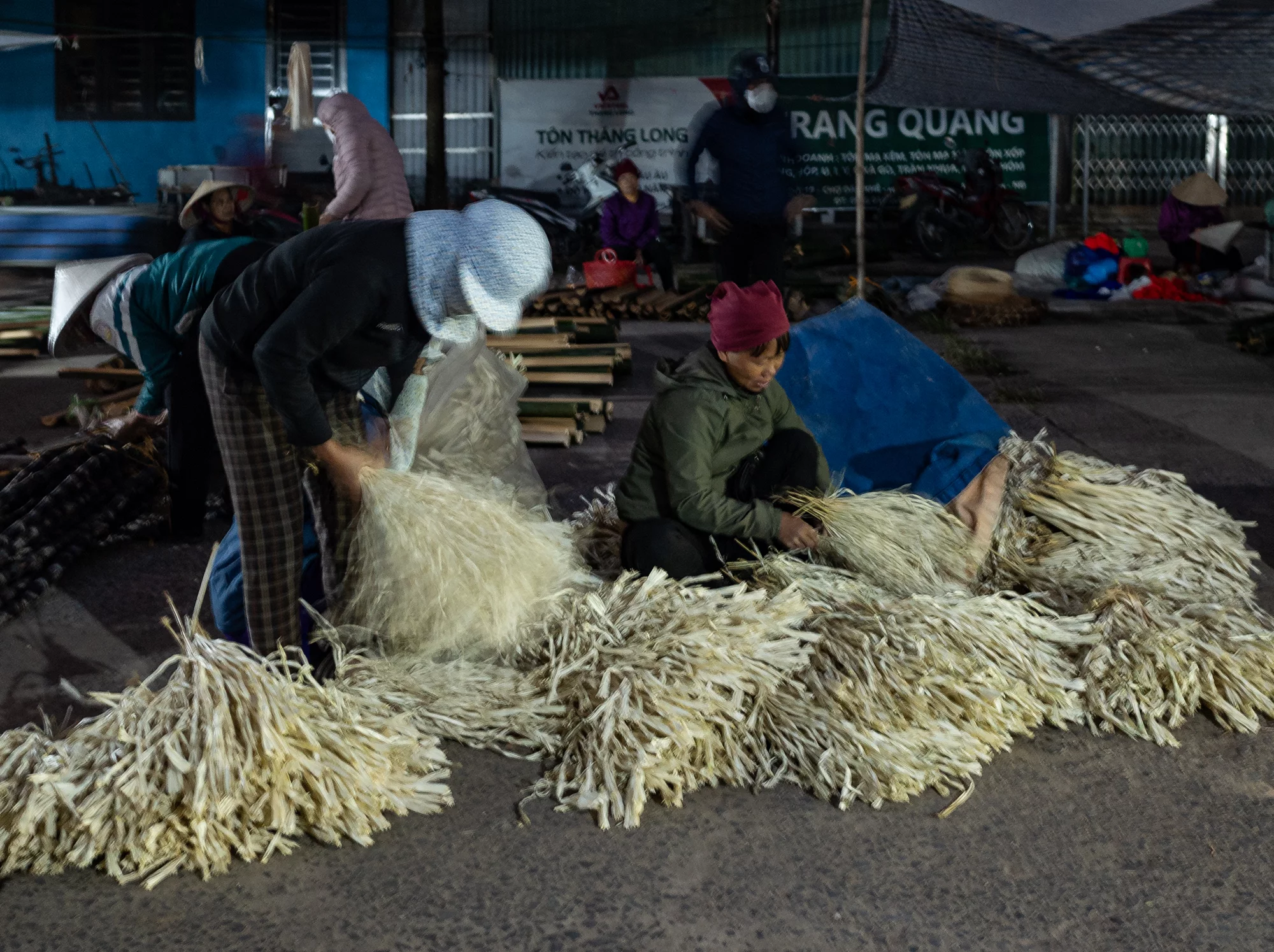
The life of Đào Khê market is another chapter of this story. By five in the morning it is already alive with the glow of white and yellow lamps. At the entrance, vendors arrange bamboo, nylon thread, palm leaves, and sheaths in neat rows. The trading is animated but fleeting, lasting only from six to eight o’clock. Speaking with Mrs. Vân, who sells bamboo sheaths, I learned why the market opens for such a short time. Sellers come only in the early hours, before hurrying back to factory shifts, household work, or their own hat-making. Buyers, in turn, rise before dawn to secure the best materials for their craft. As the market quieted and the stalls emptied, I too took my leave of Đào Khê, carrying with me the image of a village where tradition continues to unfold in the delicate rhythm of daily life.


As I waited for the bus, the memory of the women working together lingered in my mind. Their laughter and conversation, woven seamlessly into the rhythm of their stitching, stirred within me an unfamiliar joy, deepening my affection for the traditional conical hats of my homeland. Witnessing not only the craft but also the vibrant life of Đào Khê market, where the materials that give form to the hat are exchanged, strengthened my belief that this heritage will endure. Sustained by love and by a bond that has been passed down through generations, the people here will continue to preserve and renew the art of hat-making for years to come.
It is perhaps only when we look closely, when we come to understand the smallest gestures and the simplest tools, that we begin to recognize the true value of traditional crafts. In this light, the Nghĩa Châu conical hat emerges not merely as an object of daily use, but as a symbol of cultural resilience, embodying both memory and artistry in equal measure.
