
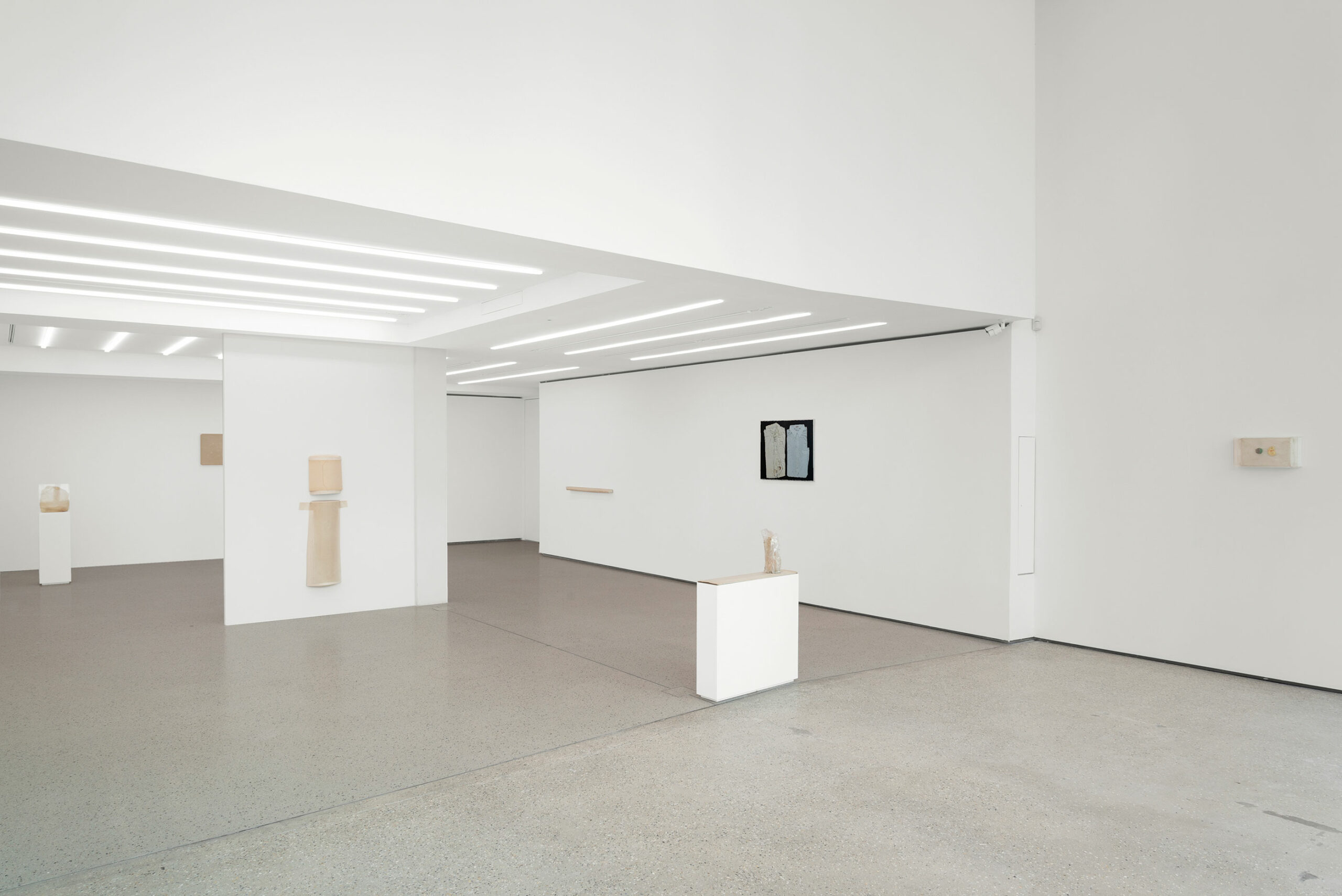
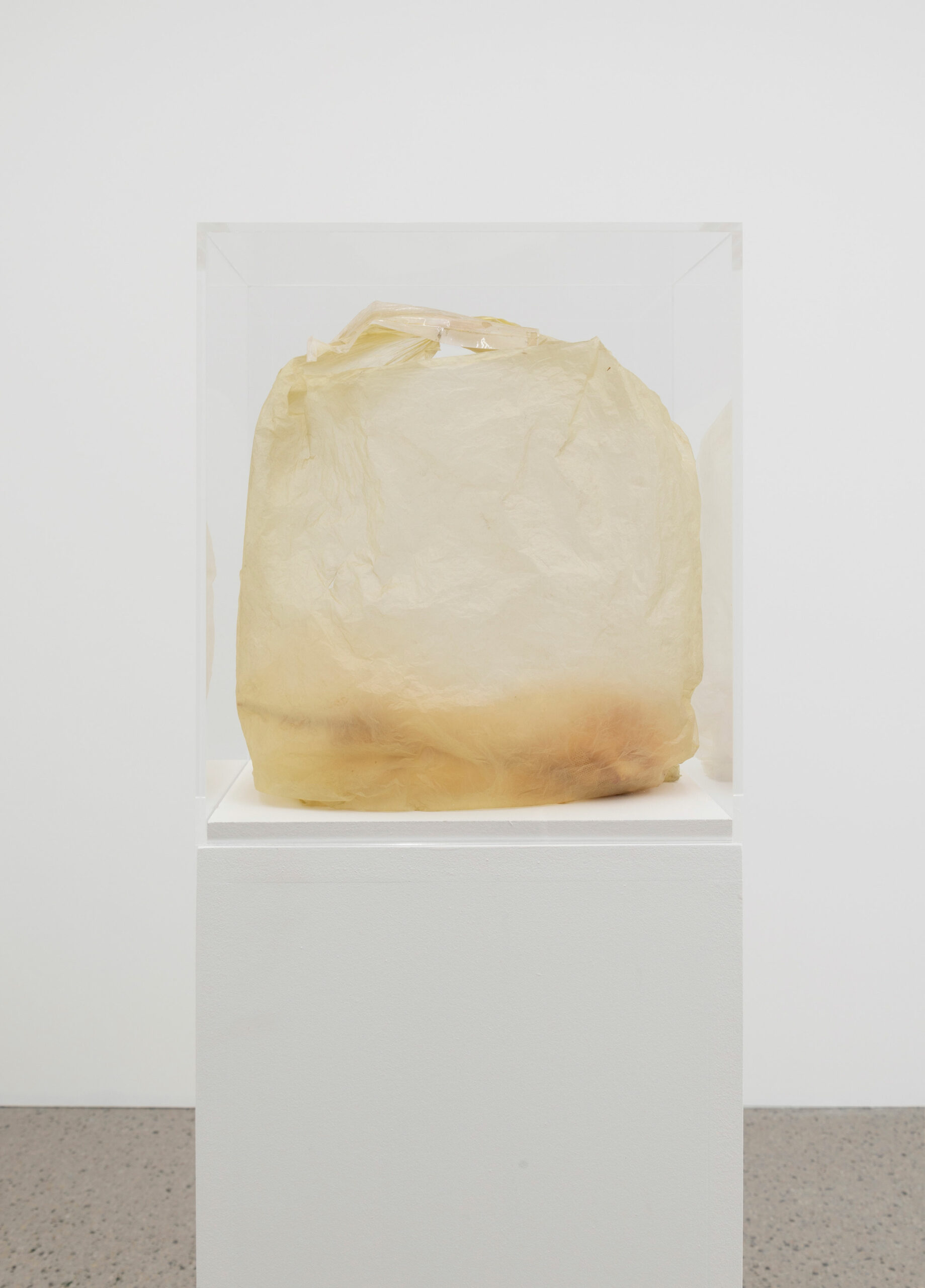
In The Carrier Bag (2025), a plastic bag, a length of ribbon, a piece of netting, and a pink rose taken from the Palaipaphos archaeological site in Cyprus are held together in a small structure. None of these elements seems built to last. The bag belongs to the short cycle of buying and packaging. The flower belongs to an even shorter span of time. The netting and ribbon were only ever meant as supporting parts. Placed within the exhibition In the main in the more at Fondation Pernod Ricard in Paris at the end of 2025, they are granted a different status: not quite treasure, yet no longer simply used-up things.
It’s a fitting place to begin looking at Beatrice Bonino’s practice. She works with things the eye tends to slide past: plastic, paper, silicone, latex, cardboard, vinyl, ribbon, containers, artificial flowers, cosmetics, food packaging, worn fabric. These materials aren’t disguised as something more refined. Bonino keeps their industrial, cheap, aged, or awkward character intact, then shifts the relationships between them through very small gestures: folding, pinning, tying, wrapping, pressing, nailing, partially concealing, or placing under glass.
If there’s a single principle running through her work, it may lie in how an object is held onto just before we stop paying attention to it.
Bonino was born in 1992 in Turin. Her path into art looks quite different from the usual image of an artist moving from art school straight into a studio. Before turning to sculpture, she spent years studying ancient languages and completed a PhD in Sanskrit at the Université Sorbonne Nouvelle. In 2023, when Erik Benjamins interviewed her ahead of her exhibition If I did, I did, I die in New York, Bonino was still working as a set designer and curator in Paris. She even said she had only just begun making art and wasn’t yet fully comfortable calling herself an artist.
That detail can be hard to picture today, given the pace at which Bonino’s career has developed, but it helps explain some of the fundamental traits of her work. She entered art with the experience of someone accustomed to studying language systems that have endured over very long stretches of time, while also being familiar with the temporariness of set design, where a space can be elaborately built and then dismantled a few hours later.
These two seemingly opposite experiences meet in her sculptures: on one side, the long endurance of language and knowledge; on the other, cheap, temporary materials that could vanish at any moment.
Bonino has described herself as someone who works fast but thinks slowly. That remark is probably more useful than any theoretical statement when looking at the work. Her assemblages don’t feel as though they were built from a predetermined drawing. They seem to emerge as the artist tests what a material can withstand, where it wants to fall or curl, how far a sheet of plastic can be stretched before its shape grows tense.
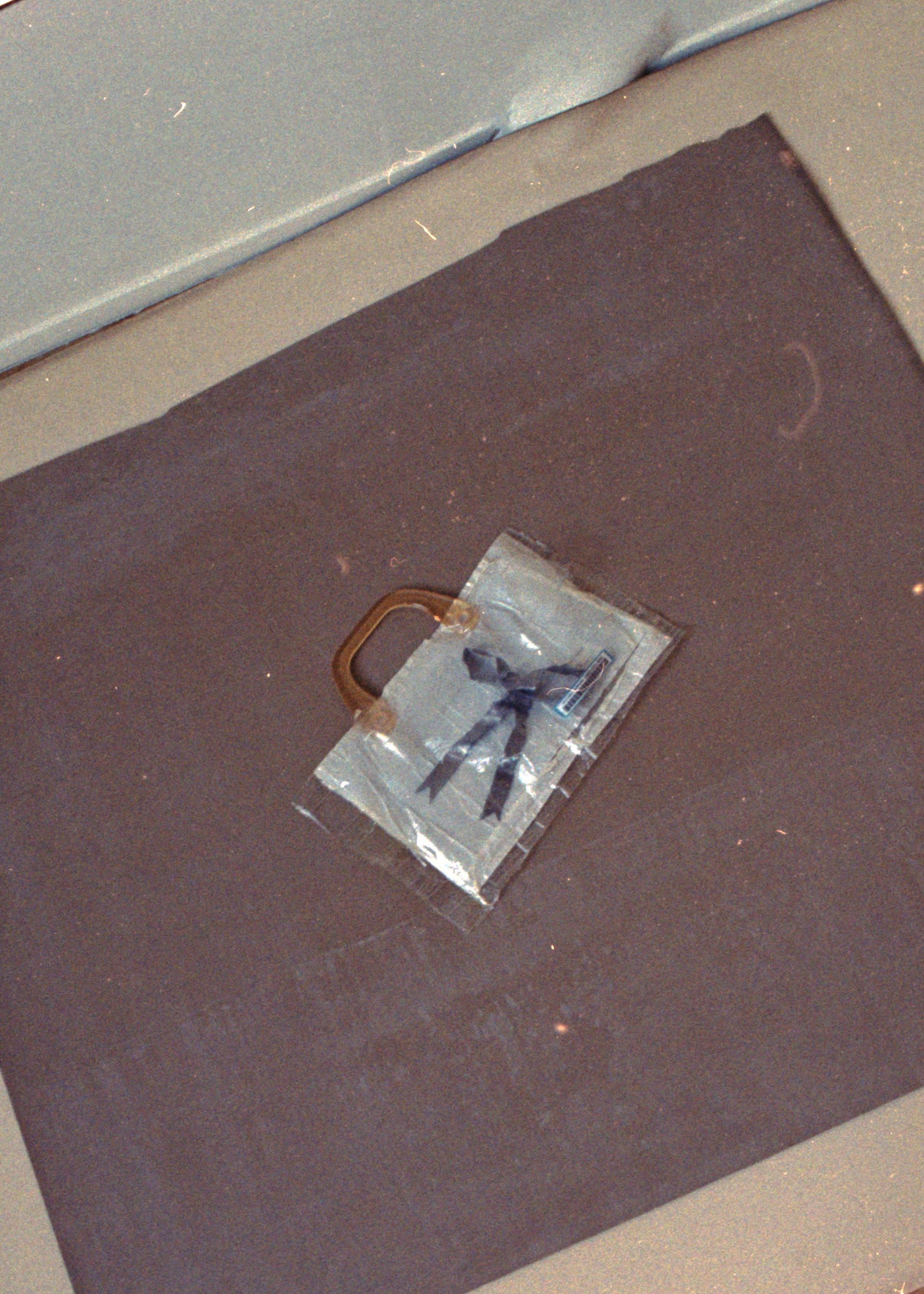
This approach shows up especially clearly in If I did, I did, I die, Bonino’s first solo exhibition in the United States in 2023. She spent several months in New York before the opening and made most of the works right there at Jacqueline Sullivan Gallery. Materials bought from the hardware store or found around the city went directly into the work. A stool was wrapped in a rose-printed plastic bag, sealed tightly under a layer of clear plastic. Black ceramic vessels were dressed in vinyl and silk. Latex, slippery and reluctant to stay put, was nailed down onto wood. Plastic, foam, rhinestones, steel wool, and artificial roses were combined into assemblages whose instability was never hidden.
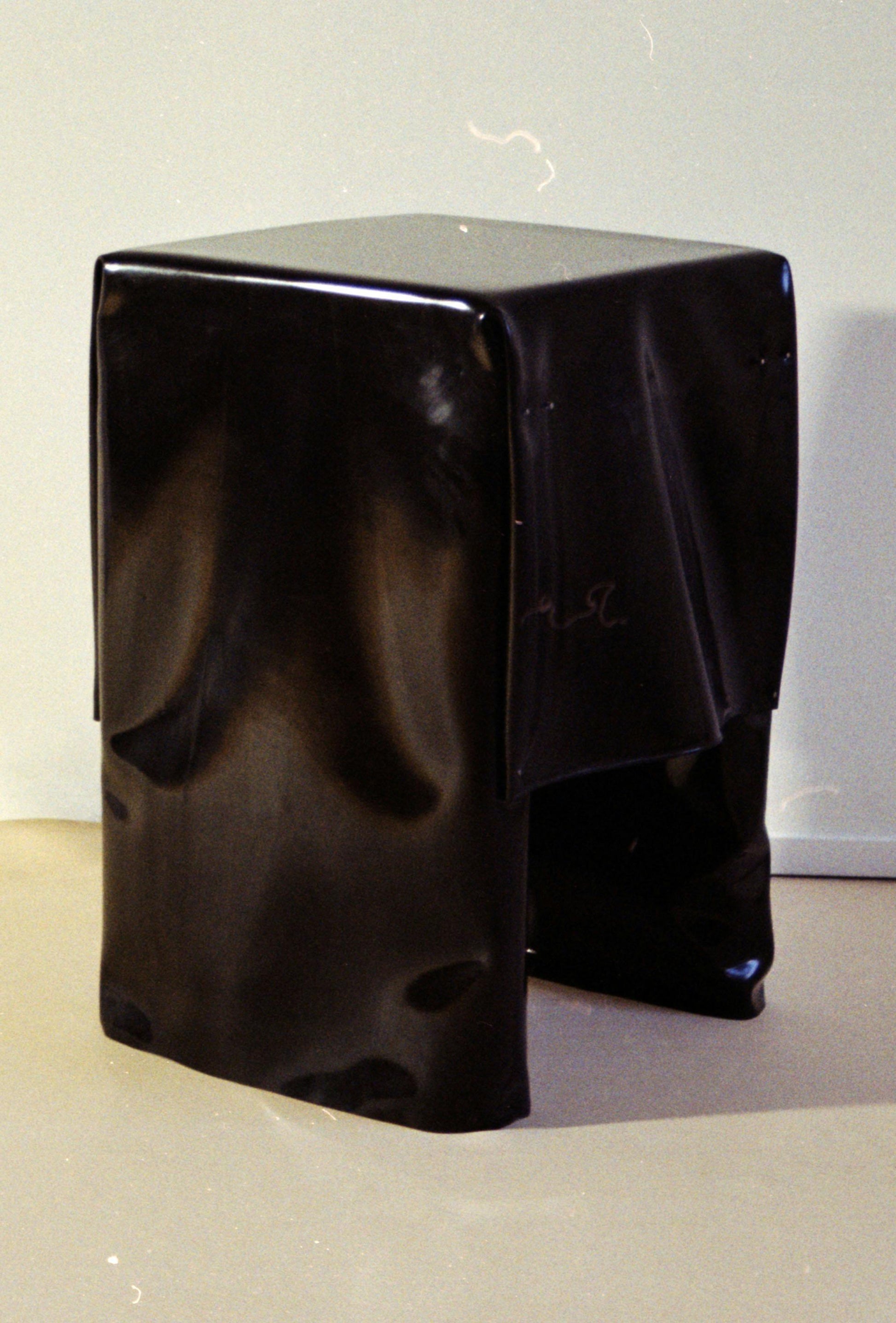
Bonino is particularly drawn to the way materials resist the hand that shapes them. She has said that watching how matter reacts to handling, tools, and pressure is a way of understanding her own inner state. While preparing the New York exhibition, she pictured herself as a ceramic mold, holding pressure from the material poured into it while still having to keep its structure intact.
Out of that experience, fastening became a central gesture in Bonino’s work. She ties, pins, nails, wraps, and holds things that tend to shift and drift. Asked why she so often uses bows, she answered simply that a bow is just another way of tying two things together.
The simplicity of that answer conceals a fairly distinctive formal instinct. In design, a joint is usually considered successful when it is clean or invisible. In Bonino’s work, the joint is allowed to stay visible, as evidence of the force acting on the object. A nail doesn’t only serve to hold something in place; it shows that the latex is being held down against its will. A layer of plastic both protects the surface beneath it and makes that surface harder to see clearly. Ribbon functions as both decoration and structural hold.
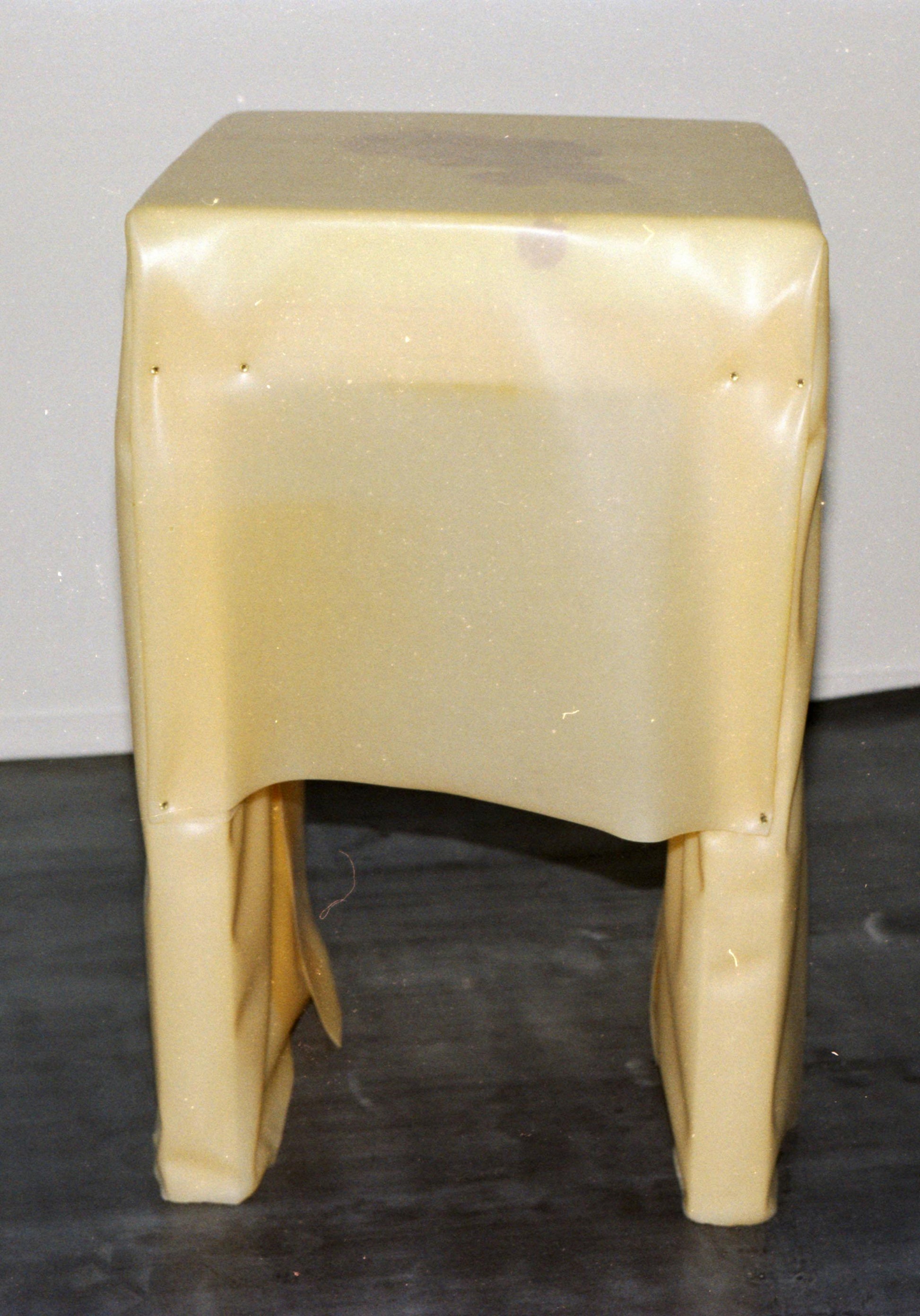
As a result, the work rarely looks finished in the classical sense. It seems to hold a temporary, provisional balance. That fragility comes from an awareness that the components retain their own separate nature and never fully dissolve into a single unified whole.
Already in the New York exhibition, Bonino extended these gestures into the space itself. A semi-transparent sheet of latex divided the gallery in two. Electrical outlets were covered in latex. The base of the sink in the restroom was concealed under a skirt-like layer of material. Plexiglass, the plinths, and the display system were no longer entirely separate from the work. Vitrines were assembled with visible adhesive, as if Bonino wanted viewers to register both how an object was presented and what lay inside it.
Her background in set design can be felt in this sensitivity to the whole room, but the more direct reference for Bonino at the time was The Art of Memory by Frances A. Yates. In Yates’s study of classical mnemonic techniques, a speaker could imagine a building and place the images to be remembered at different points within it. To recall the speech, the speaker would walk back through the imagined architecture and retrieve each memory from where it had been set.
Bonino recognized a kinship between that method and the way she imagines a body of work. Objects don’t exist in isolation but are conceived within a mental space, then arranged in the gallery as a route to be walked. Here, architecture doesn’t simply serve as a backdrop for the sculptures; it takes part in how those sculptures are remembered.
Memory in Bonino’s work therefore doesn’t need a specific story. It lives instead in the way matter carries the traces of time.
Her earliest black ceramic works are one example. Bonino learned coiling and hand-building techniques while in Australia, about five years before the New York show. She likes to imagine that a fragment of thought gets caught in each coil of clay pressed into place. When Benjamins remarked that the unglazed vessels looked like domestic objects that had turned into ghosts, Bonino replied that she, too, thought of the thoughts held inside them as ghosts that never escape.
That way of thinking opens onto a trait that keeps recurring in her later work: the object doesn’t illustrate memory, it becomes a place memory can cling to.
In Cosetta, first shown at MMXX in Milan in 2023 and later developed into an exhibition at Bonner Kunstverein in 2024, the focus shifts more clearly toward a question of value. One sheet of paper among hundreds of others, one scrap of plastic among thousands — why is one thing kept and not the rest?
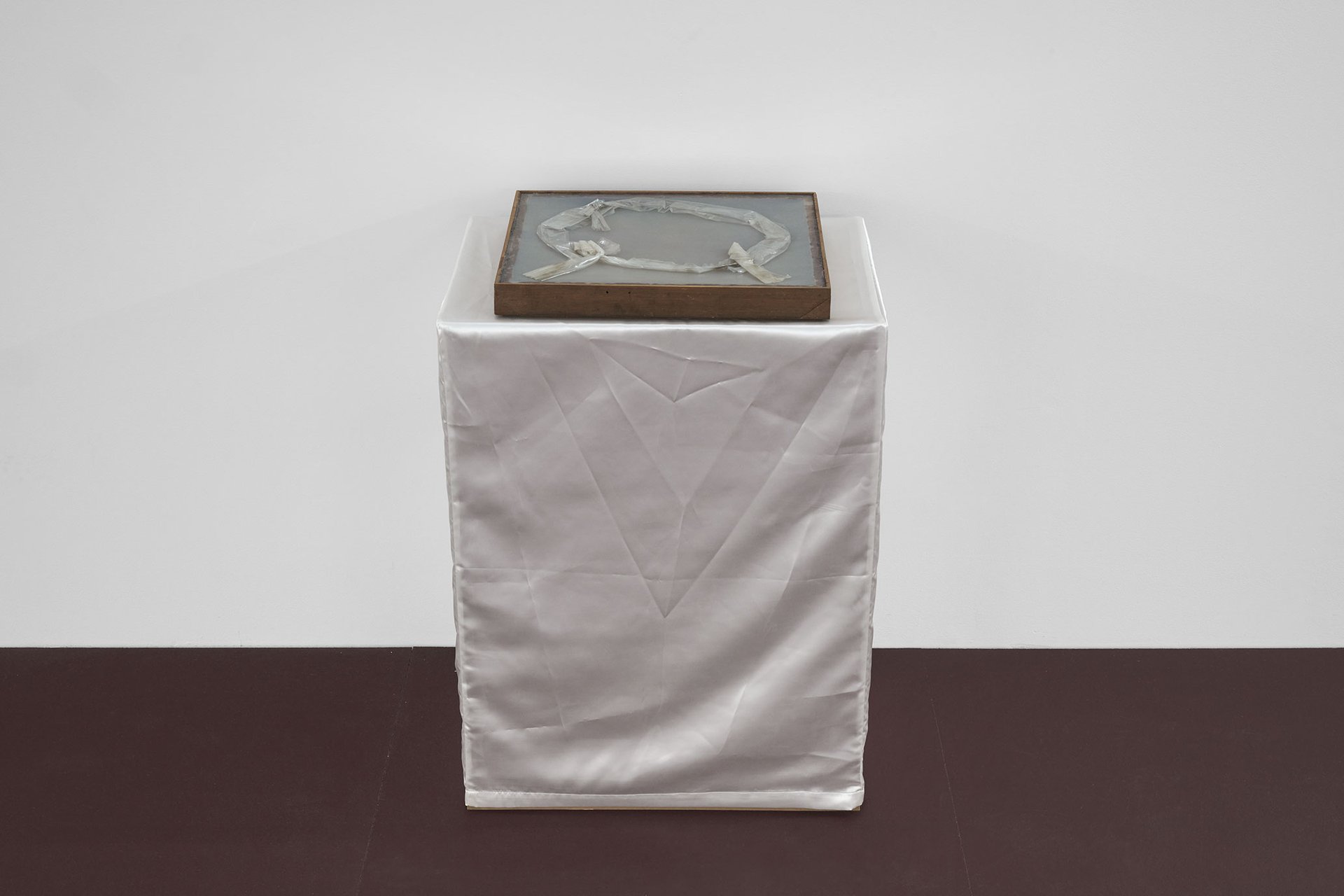
Here, the artist’s act of selection carries as much weight as the act of shaping. Materials nearly identical to countless others become rare simply because one of them was seen, picked up, and chosen. What makes the work isn’t only accumulation, but also the enormous quantity of things that were passed over.
Bonino doesn’t try to turn that process into a kind of magic trick where trash suddenly becomes precious. Scraps of plastic still look like plastic. Cardboard still carries its fold lines and the cheapness of packaging. Paper can still discolor. The chosen object doesn’t need to shed its ordinary origins in order to become worth noticing.
By the time of The opposite of low hanging fruit at Radio Athènes in 2025, the accompanying text borrows a phrase, quoted from Bernadette Corporation’s novel Reena Spaulings, to name that in-between zone: pre aesthetic. It can be understood as the moment just before an object settles fully into being beautiful or ugly, precious or cheap, appealing or meaningless. The artist has said her process is, for the most part, one of taking away.
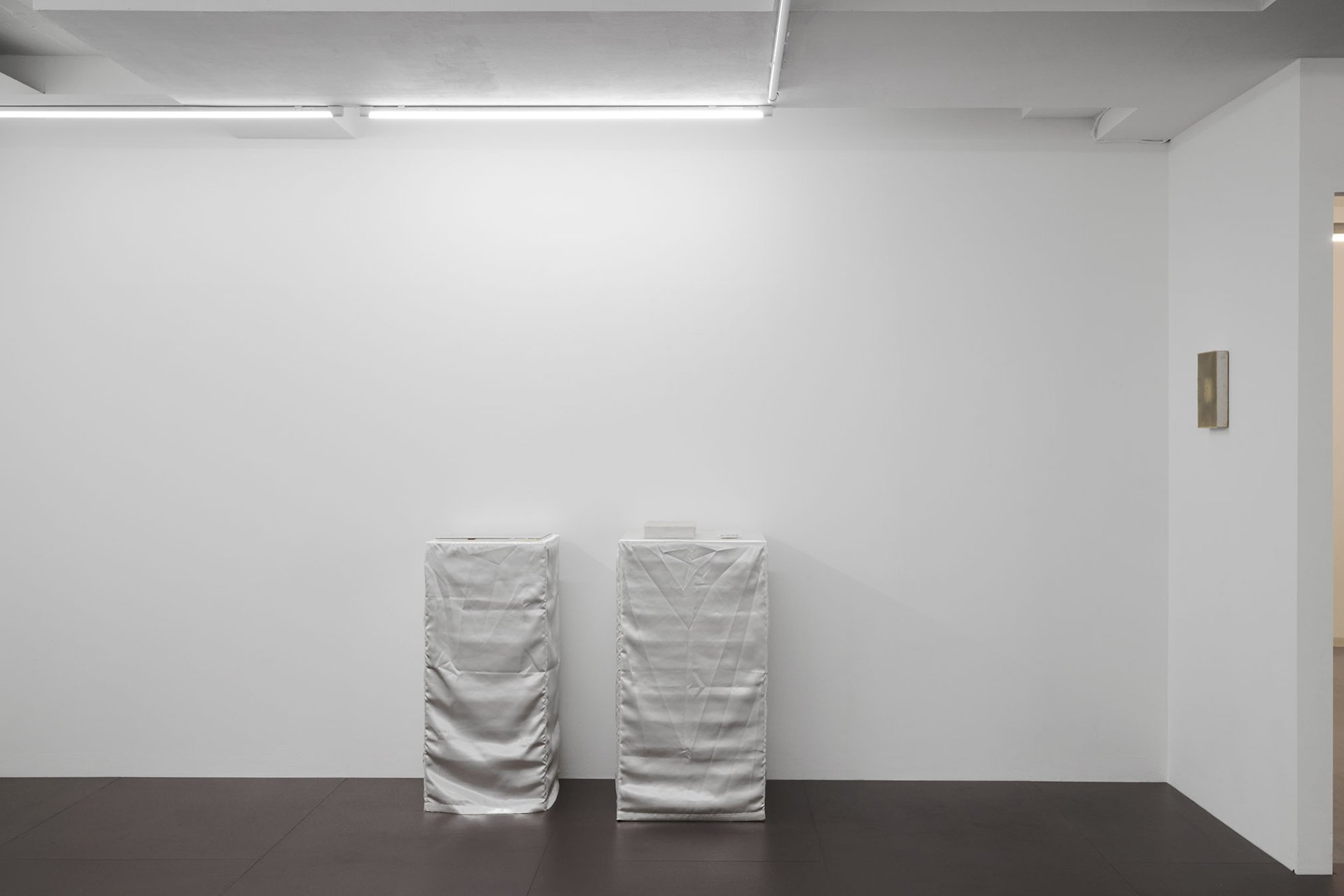
This approach becomes clearer looking back at Gallerina at Galerie Molitor in Berlin in 2024. The exhibition space was covered almost entirely in worn whites, creams, beiges, and grays. On the walls, paper and cardboard structures sat inside plexiglass. Two sculptures titled Bed, roughly the size of a single mattress, sat low on the floor, made of rigid nylon with silicone, plastic, and paper layered over the surface.


According to Galerie Molitor, Bonino conceived these beds in relation to stone slabs or church tomb effigies, where the shape of a body is recorded onto a flat surface. From a distance, Bed could resemble a mattress, a flat stone slab, an overturned box, or a surface meant for a body that is no longer there.
This marks an important development: domestic space is still present, but household objects no longer need to appear intact. A bed can become a flat plane. A box can be opened up and lose its ability to hold anything. Packaging becomes surface.
Writing about Gallerina, Bryony Dawson paid particular attention to the gesture of folding: paper folded, plastic folded, the edges of plexiglass folded, cardboard opened flat and then reassembled. The distinction between inside and outside starts to become difficult to pin down.
A box, once flattened, still carries every sign of having once been a container, yet it can no longer hold anything. It has lost its function while still retaining the memory of that function.
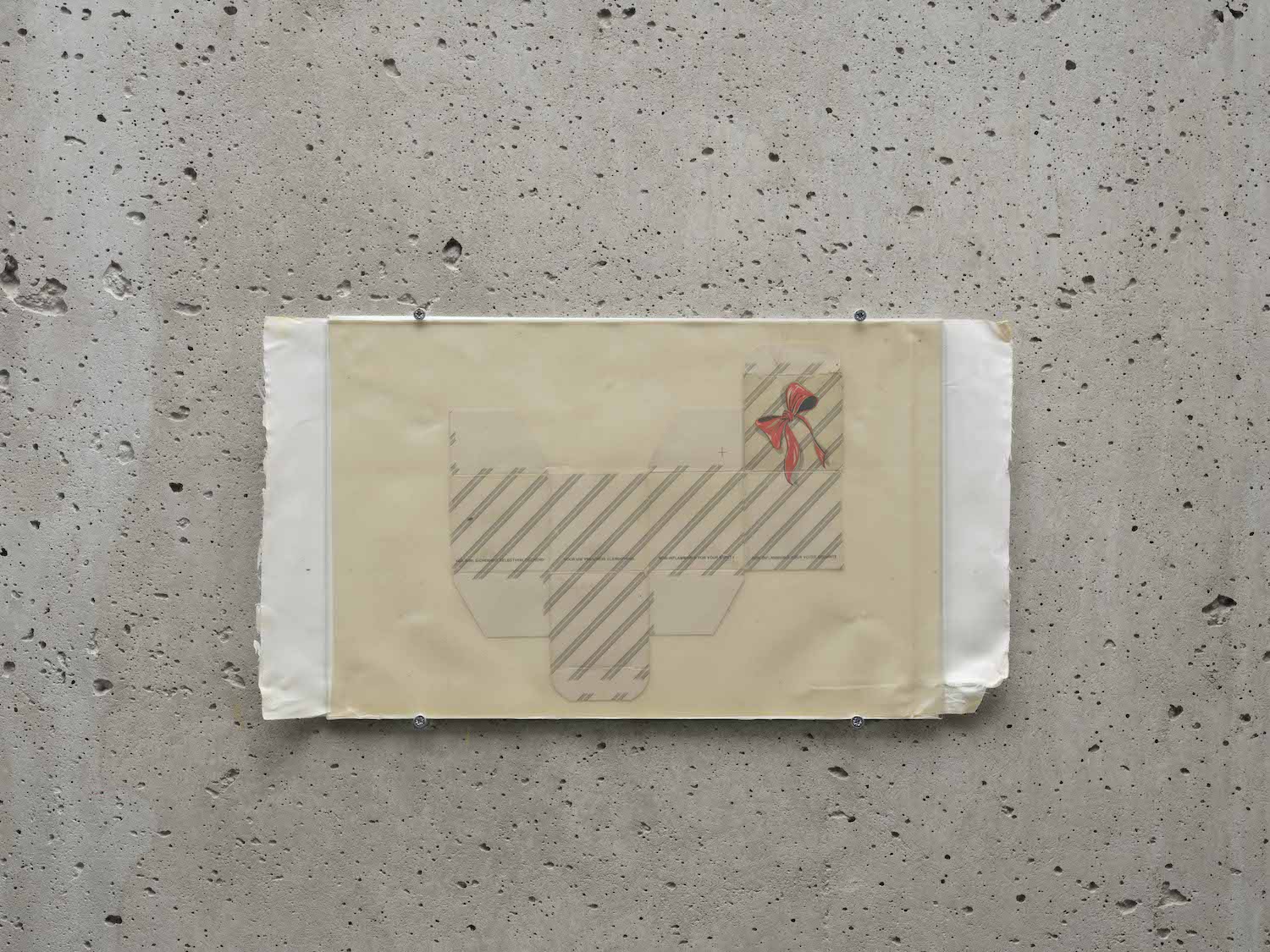
In Bonino’s work, these transitional states are often more suggestive than any finished form.
Orlo (2024), shown in Kill Your Darlings at Ermes Ermes in Rome, follows the same logic. Behind a sheet of glass sits a piece of curtain with a burn hole, a finished hem, and a single thread running horizontally across it. The burn was never mended. In Oinops pontos (2024), a found photograph is held under a layer of plastic, its title evoking the Homeric image of the wine-dark sea.
These works make clear how Bonino’s years spent on ancient languages inform her practice without turning her sculpture into an illustration of academic research. What interests her is how a thing can move through time, change form, and still retain traces that let us recognize it once existed.
In the text On the notion of existence, written to accompany the Rome exhibition, existence is framed in relation to action and transformation. That way of thinking sits closer to what actually happens in Bonino’s materials than any symbolic statement could. An object isn’t preserved in order to become motionless. It keeps aging, warping, discoloring, or deforming even while it is being held onto.
The vitrine in her work therefore plays a contradictory role: it both protects and, at the same time, makes viewers more aware that the object inside is aging.
By In the main in the more at Fondation Pernod Ricard, that tension reaches a new degree of concentration. The exhibition was organized together with Catherine David and placed Bonino in dialogue with artists from several different generations, including Lutz Bacher, Jean Pierre Bertrand, Matt Browning, Gianni Colombo, Giuseppe Desiato, Marisa Merz, Dieter Roth, and Giorgos Tigkas.
The presence of these artists doesn’t turn Bonino into the direct heir of a movement. What matters more is how the exhibition reveals a broader history of practices concerned with ordinary matter, traces, decay, preservation, and the instability of form.
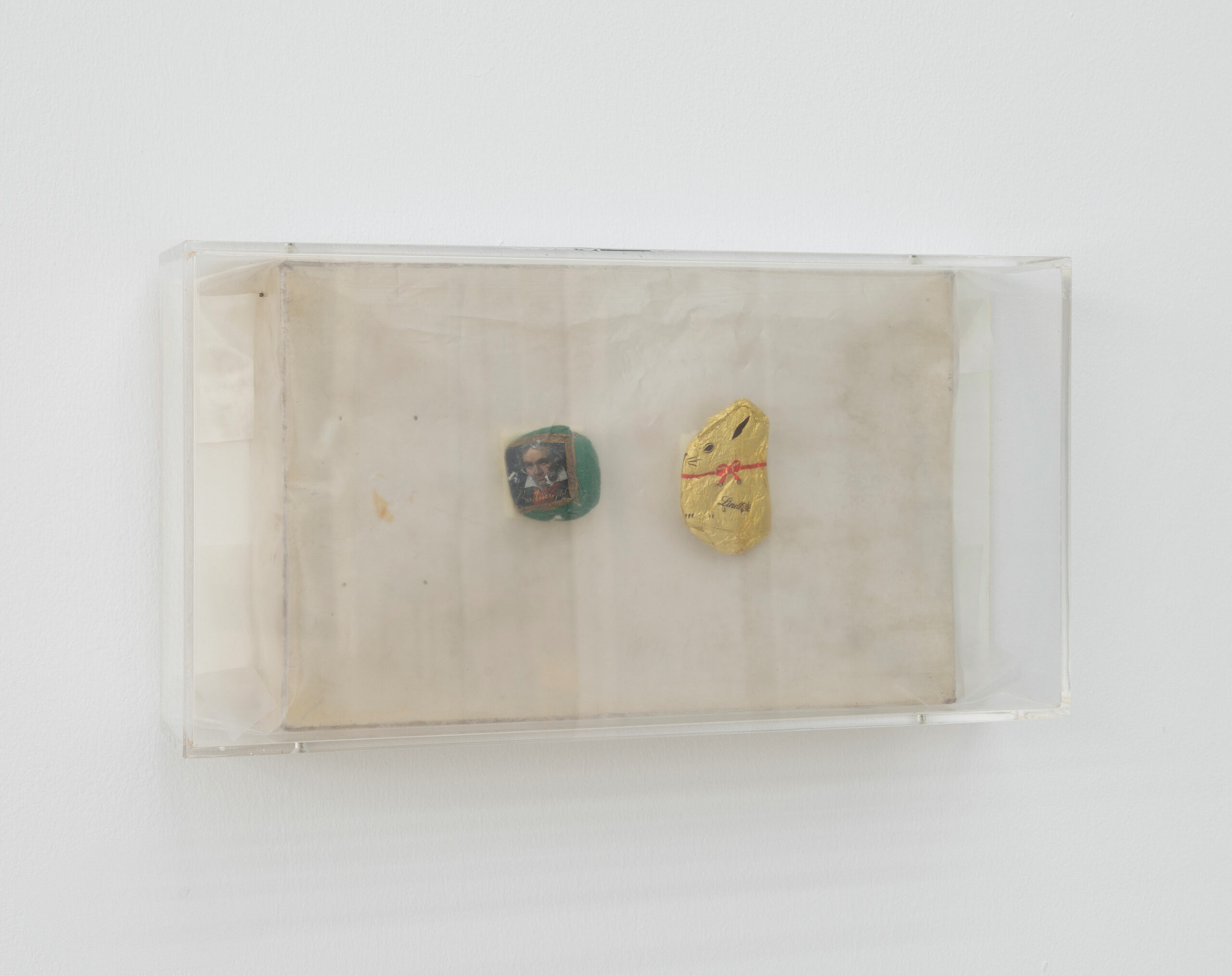
Funny and Fun (2024) is one of the most condensed works in that context. Chocolate, paper, plastic, and aluminum foil are held together in a small structure. A product that belongs to immediate consumption is treated with the kind of care usually reserved for a specimen or a keepsake. What’s strange isn’t that chocolate becomes art. It’s the enormous gap between the object’s expected lifespan and the level of care it receives.
The Carrier Bag works in a similar way, but more quietly. The plastic bag isn’t hidden. The rose from Palaipaphos carries a connection to an archaeological site, but Bonino doesn’t build a historical narrative around it. She places an object rooted in a place tied to very long layers of time alongside a material that represents today’s fast-use, fast-discard economy.
What emerges is a kind of archaeology of the present, though this is better understood as one reading of the work than as a statement from the artist. Bonino seems to gather matter before it is old enough for society to call it a relic. She gives things that have only just begun losing their value a degree of attention that normally only appears once time has made them rare.
It would be easy to read all of this as a direct commentary on consumer culture. Plastic, packaging, chocolate, cosmetics, cheap goods could all lead a viewer toward a story about production and waste. But Bonino’s art doesn’t really function as an indictment. She doesn’t place objects in the gallery so they can serve as evidence for an argument already decided in advance.
What she does is closer to changing the speed at which we look.
A scrap of material sitting in a hardware store long enough to gather dust can catch her attention. A cardboard box that has lost its function can be kept for its fold line. A length of ribbon can be used for the way it ties two things together. A burn mark on a curtain can be left as it is because it has changed the material in a way that can’t be undone.
The precision in Bonino’s work lies in her ability not to do too much after that moment of recognition.
That’s also why her sculptures look modest but never accidental. The materials look as though they were simply found, yet the relationships between transparency and opacity, softness and hardness, flatness and volume, concealment and exposure are all tightly controlled. Bonino makes viewers move closer, bend down, look through a layer of material, or shift position in order to notice a single detail.
Catherine David has pointed to Bonino’s willingness to accept opacity in her work. This is an important idea, since the sculptures never promise that looking longer will lead to a final answer. A piece of cardboard doesn’t become a symbol with a fixed meaning. A bow doesn’t always stand in for femininity. A bed doesn’t necessarily tell the story of a specific body.
Bonino holds on to a part of the object that can never be fully read.
Her background in language study may well be what makes her comfortable with that state. Anyone who has worked with ancient texts knows that what survives is never equal to the whole that once existed. A fragment isn’t a solution to the past. It only proves that a larger structure once surrounded it.
Bonino’s sculptures often produce a similar feeling. They resemble fragments from a domestic interior that has vanished, packaging with no product left inside it, a body no longer lying on a bed, a story the viewer has arrived too late to hear from the beginning.
Yet that sense of absence never tips the work into melancholy. Bonino has a very quiet sense of humor, visible in chocolate kept far too long, in a bow made from an unsuitable material, in the way a thoroughly ordinary object is placed under plexiglass with an almost excessive degree of seriousness. That humor keeps the work from slipping into a romanticized view of old things.
Over the past few years, from If I did, I did, I die to In the main in the more, Bonino’s language has grown clearer without hardening into a recognizable style. The materials may change, but certain gestures keep returning: selecting, holding, pinning, wrapping, folding, placing things side by side, letting joints show, controlling how much is visible, and accepting that the material will keep changing.
More importantly, she has shifted the question from how an object can become a sculpture to a harder one: what makes us decide that an object deserves to keep being looked at?
At a moment when images and objects are constantly produced and replaced, that question carries real weight. Bonino doesn’t try to resolve this excess by building an aesthetic of recycling, nor does she turn discarded things into moral symbols. She chooses a smaller and perhaps harder gesture: staying with an object long enough to realize that even the most ordinary thing has a complicated material life.
The plastic bag in The Carrier Bag is still a plastic bag. It doesn’t become precious simply by being placed in a gallery. The rose isn’t rescued from time either. They are simply held next to each other for longer than expected.
That extended stretch of time is where Beatrice Bonino’s art truly begins.
Cover image
Installation view of In the main in the more at Fondation Pernod Ricard, Paris, 2025. Photo by Simon Rao.
Sources
Jacqueline Sullivan Gallery, PIN–UP Magazine, Mousse Magazine, Bonner Kunstverein
Galerie Molitor, Émergent Magazine, Flash Art, Radio Athènes, Fondation Pernod Ricard
Frieze, Artforum